
Molecular Quantum Information
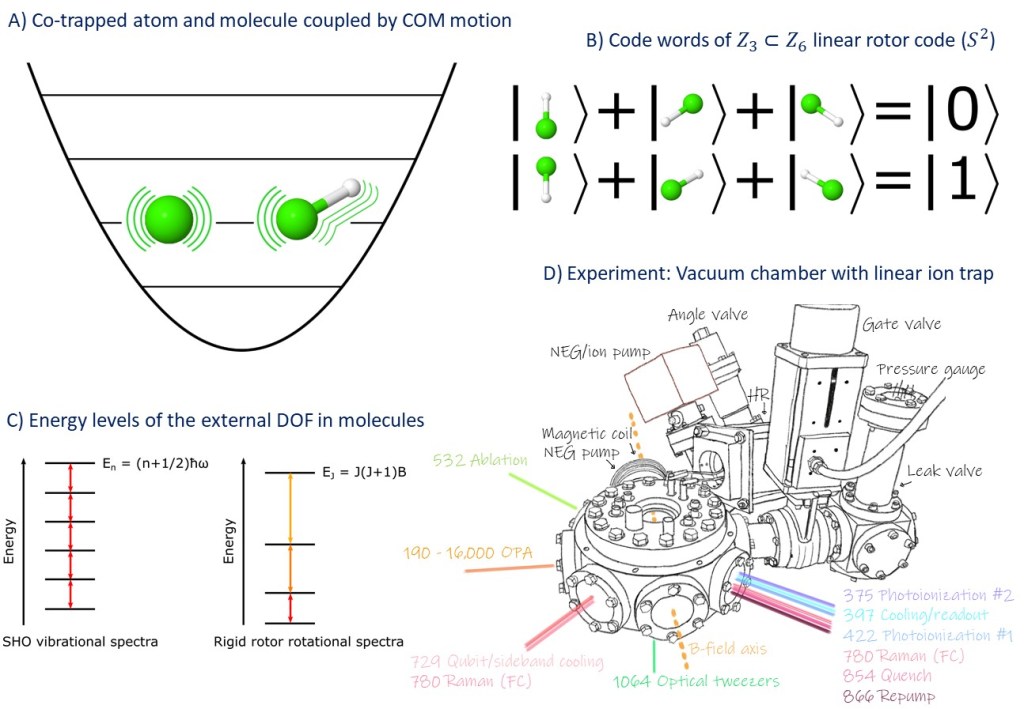
Quantum computing has the potential to solve computational problems that are not accessible to current computers. However, any implementation is subject to noise and quantum error correction (QEC) is used to protect quantum information in order to run long algorithms. Such correction procedures encode information redundantly, usually spreading out information onto multiple quantum particles. This redundancy incurs a resource overhead which can be reduced by encoding with higher-dimensional quantum systems. Recently, several classes of QEC codes for encoding quantum information redundantly in the rotation of a single molecule have been proposed. Within this project, we aim to identify, analyze, and demonstrate efficient implementations of quantum error correction with single molecules. This project will lay the experimental and theoretical groundwork for such an efficient QEC scheme based on molecular external degrees of freedom. We aim to develop a fault-tolerant framework to create non-classical states and readout error syndromes. We will also explore mechanisms that enable fault-tolerant quantum operations between two molecules, each encoding a logical qubit.
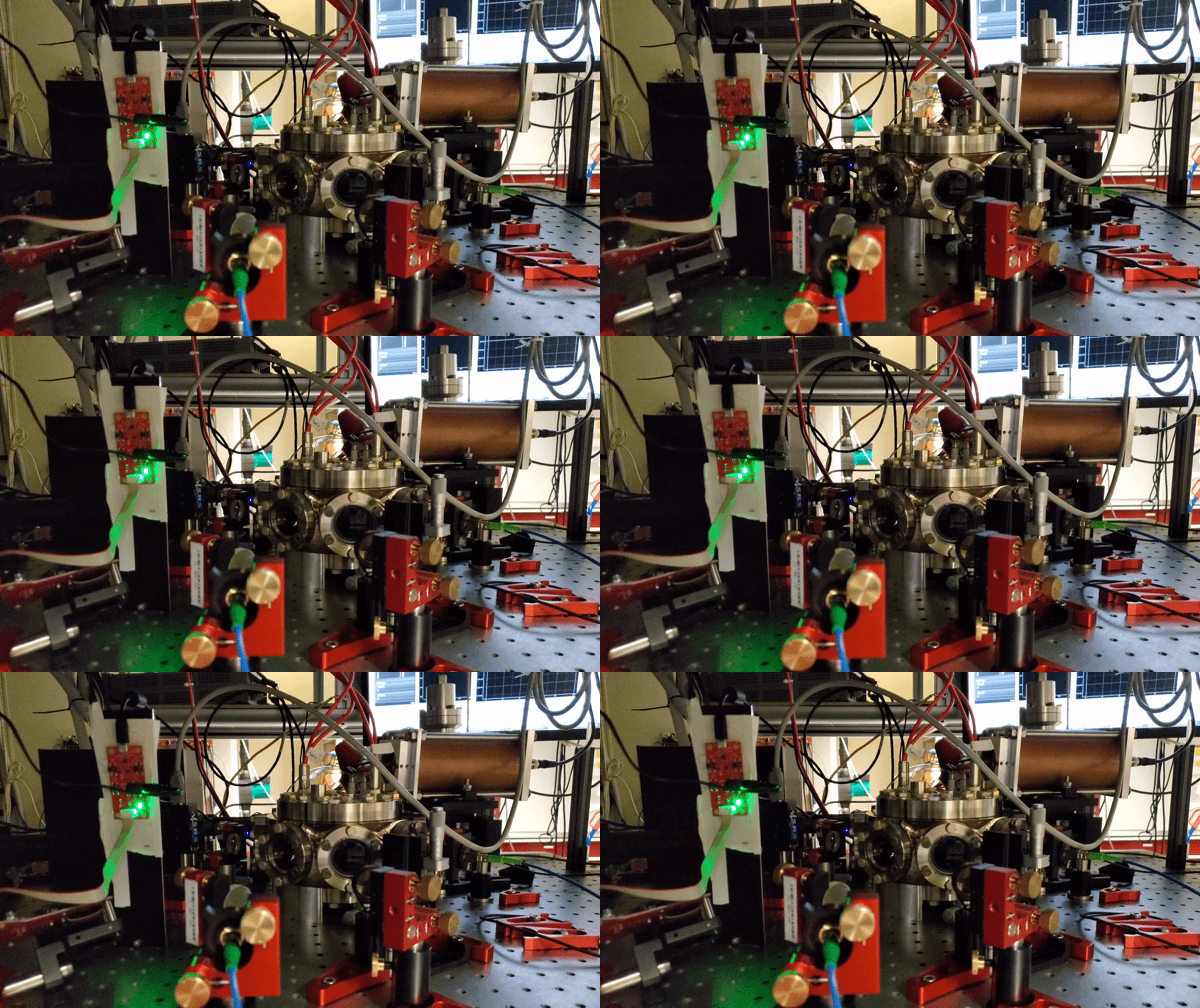
The experiment consists of an ion trap quantum computer, in which atomic and molecular ions are co-trapped. Quantum logic spectroscopy is used to transfer quantum information between the molecular and atomic ions. This is used to prepare the system in a pure state, to retrieve information on the error processes, and for the final state measurement. We plan to use CW and frequency comb Raman, microwaves, and continuous-variable control over the angular momentum and vibrational states of the molecule. In addition to quantum computing applications, the combination of robust quantum states with molecular systems might drastically improve precision experiments searching for new physics, such as measuring the electron dipole moment. Creating robust states of molecular degrees of freedom can also serve as the basis to control state-selective chemical reactions, opening new research avenues in physics, chemistry, and biology.
Details

- Funding: FWF 1000 Ideas (Quantum Austria Initiative): Molecular Quantum Error Correction (Brandon Furey) and ERC Horizon Starting Grant: QCosmo (Philipp Schindler)
- 2022 — present
- Universität Innsbruck
- Principal Investigators: Dr. Philipp Schindler and Prof. Rainer Blatt
Two-Photon Absorption Spectroscopy of Semiconductors and Silicon Quantum Dots

Semiconductors are not only building blocks of modern microelectronics, but have become important photonic materials for telecommunications and integrated light wave systems.3 Numerous photonic applications for nanocrystalline semiconductor quantum dots have emerged in recent years, including spin qubits in photonic networks, quantum dot light-emitting diodes, in vitro and in vivo biological imaging, and cancer therapy. Some of these applications use two-photon absorption (2PA) directly to excite photoluminescence, taking advantage of the availability of ultrashort, high-peak-intensity laser sources and/or high sample transparency at the excitation wavelength. In other applications, 2PA is an undesired performance inhibitor that must be understood and managed.2
I studied 2PA spectra and size-dependence in nanocrystalline silicon quantum dots synthesized by my collaborators in Prof. Brian Korgel’s chemical engineering group at the University of Texas at Austin. My collaborators in Dr. Bernardo Mendoza’s theory group at the Centro de Investigaciones en Optica (CIO) in Leon, Mexico are developing a theoretical model for 2PA spectra of Si quantum dots which depends on ab initio calculations for bulk Si. Thus, I also measured the 2PA spectra of bulk semiconductors to compare to these calculations. To this end, I designed and built a pump-probe modulation spectroscopy experiment to measure time-resolved 2PA spectra and anisotropy in GaP, GaAs, and Si in Dr. Ramon Carriles’s lab at CIO.
Manuscripts
- Nonlinear Absorption Spectroscopy of Bulk Semiconductors and Nanocrystalline Silicon Quantum Dots by Brandon J. Furey, Doctoral dissertation, University of Texas at Austin, Austin, Texas, United States (2021).
- Two-Photon Excitation Spectroscopy of Silicon Quantum Dots and Ramifications for Bio-Imaging by Brandon J. Furey, Benjamin J. Stacy, Tushti Shah, Rodrigo M. Barba-Barba, Ramon Carriles, Alan Bernal, Bernardo S. Mendoza, Brian A. Korgel, and Michael C. Downer, ACS Nano (2022), arXiv:2112.12241v1 [physics.app-ph].
- Im{χ(3)} spectra of 110-cut GaAs, GaP, and Si near the two-photon absorption band edge by Brandon J. Furey, Rodrigo M. Barba-Barba, Ramon Carriles, Alan Bernal, Bernardo S. Mendoza, and Michael C. Downer, J. Appl. Phys. 129 (18), 183109 (2021), arXiv:2102.07072v2 [cond-mat.mtrl-sci].
- Two-photon absorption spectroscopy and anisotropy of Gallium phosphide by Brandon J. Furey, Rodrigo M. Barba-Barba, Alan Bernal, Ramon Carriles, Bernardo S. Mendoza, and Michael C. Downer (2019) unpublished.
- Measurement of two-photon absorption of silicon nanocrystals in colloidal suspension for bio-imaging applications by Brandon J. Furey, Dorothy A. Silbaugh, Yixuan Yu, Adrien C. Guillaussier, Arnold D. Estrada, Christopher Stevens, Jennifer A. Maynard, Brian A. Korgel, and Michael C. Downer, Phys. Status Solidi B 255 (4), 1700501 (2018).
Details

- 2012 — 2021
- University of Texas at Austin and Centro de Investigaciones en Optica
- Supervisor: Prof. Michael C. Downer
- Collaborators: Prof. Brian A. Korgel, Prof. Ramon Carriles, and Prof. Bernardo S. Mendoza
Ion Trapping and Time-of-Flight Mass Spectrometry
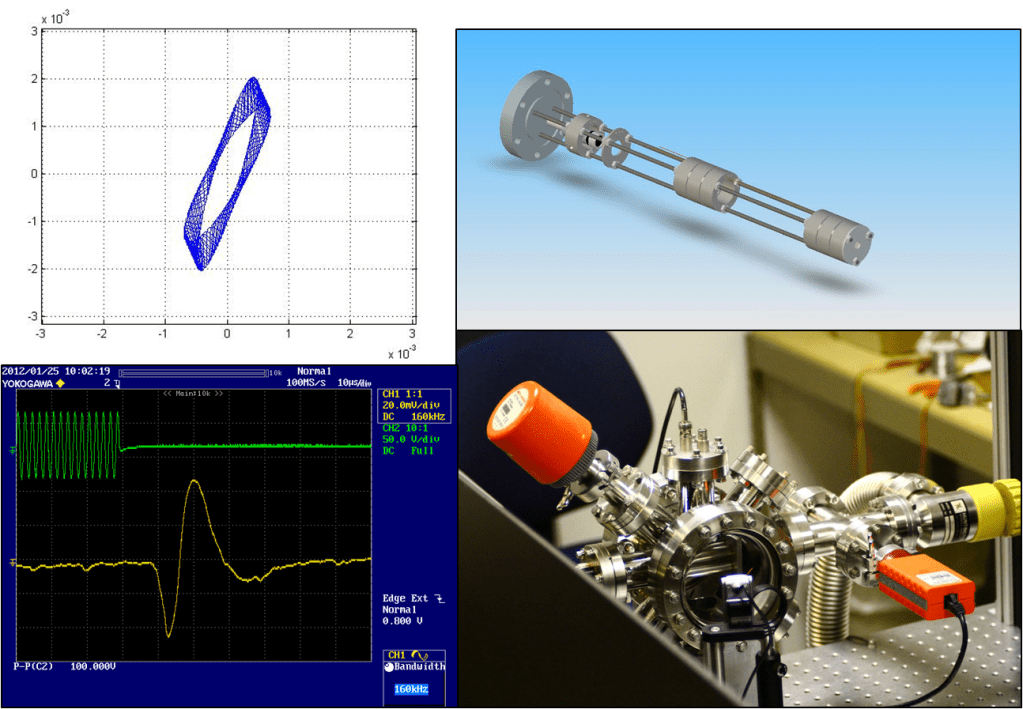
Ion traps are used to confine molecular ions which can then be identified using mass spectrometry or cooled and used to study quantum state manipulation or measure the values of fundamental physical constants. Ion traps are one possible architecture for building a quantum computer.
I completed the development of a linear quadrupole ion trap and successfully demonstrated the trapping of ions produced by laser ablation of SrF2. I also built a time-of-flight mass spectrometer which utilizes radial extraction of ions from the trap which are then collimated using Einzel lenses during their passage through the drift tube.
Manuscript
Development of a time-of-flight mass spectrometer using radial extraction from a linear quadrupole ion trap by Brandon J. Furey (2012) unpublished.
Details

- 2011 — 2012
- Gustavus Adolphus College
- Supervisor: Prof. Jessie Petricka
Airborne Hyperspectral Imaging and Modeling Actual Evapotranspiration of Almond and Pistachio Orchards

Modeling actual evapotranspiration from remotely-collected hyperspectral imagery data allows large areas of land to be evaluated for water stress and the effectiveness of agricultural irrigation by comparison to potential evapotranspiration. With less water being available in the future coupled with rising agricultural demand, more efficient irrigation practices will be necessary.
The NASA Student Airborne Research Program utilizes the NASA DC-8 aircraft as a platform for airborne research and remote sensing. I focused on the estimation of actual evapotranspiration from almond and pistachio orchards using SEBAL and METRIC models. These rely on hyperspectral imagery we obtained during overflights using the MODIS-ASTER Airborne Simulator instrument as well as surface parameters. The Land Team collectively worked on calibration of input variables, which included geometric calibration, reflectance effects, thermal infrared and near-visual infrared calibration, atmospheric effects, calculation of equivalent water thickness, and calculation of leaf-area index. I developed a code for the SEBAL model, and evaluated the actual evapotranspiration for the imagery we collected and compared the results from both this and the METRIC models.
Presentation
Modeling actual evapotranspiration: Using airborne remote sensing to compare SEBAL and METRIC by Brandon J. Furey, AGU Fall Meeting, (2011).
Details
- 2011
- NASA Student Airborne Research Program at University of California Irvine and Dryden Aircraft Operation Facility
- Supervisors: Prof. Shawn Kefauver, Prof. Susan Ustin, and Dr. Emily Schaller
- Funding: NASA Airborne Science Program
 Brandon J. Furey